
By Henrik Nakskov, CEO and Head of Clinical Information Management
May 28, 2026
By Henrik Nakskov, CEO and Head of Clinical Information Management
The science was strong. The Phase I study was progressing well. The management team believed they were ready.
A biotech startup with 18 employees was preparing for its first major investor due diligence round.
But during the diligence process, the investors due diligence supporting auditors started asking operational questions:
- Where is the latest approved protocol version?
- Can you show the training records for outsourced study personnel?
- Who approved the TMF changes made by the CRO?
- How did you qualify your CRO?
- Have you audited your lab vendor?
- Are your systems and information management under control?
- Is there a complete audit trail for document updates?
At first, the team thought these would be easy requests.
Instead, the search began.
Documents were spread across SharePoint folders, personal inboxes, Excel files and local desktops.
Different versions of the same file existed in parallel. Training records were incomplete. Some approvals had happened informally via email or Teams chats. Critical documents could not be retrieved immediately.
Nobody had intentionally created risk. The company had simply grown faster than its operational foundation.
Within days, the discussion shifted.
The investors were no longer evaluating only the science. They were challenging operational control.
And suddenly, the company faced a difficult realization:
Inspection readiness is not something you prepare for shortly before an audit. It is an operating model that must exist long before pressure arrives.
Why Emerging Biotech Companies Lose Operational Control
In the early stages, operational fragmentation rarely feels dangerous. Lean teams move quickly. Processes are informal. People solve problems pragmatically.
Documents are stored “wherever works.” Oversight is often distributed across internal teams, CROs, consultants, and external partners.
At first, this flexibility feels efficient. But complexity grows much faster than many organizations expect.
A company that starts with one study, one CRO and a handful of employees, can suddenly find itself managing multiple vendors, expanding documentation requirements, training records, CAPAs, protocol amendments,… and more.
And this is the point where operational shortcuts start becoming operational risk.
Not because teams are careless. But because the organization lacks a structured operational model for compliance, traceability, and oversight.
The Hidden Cost of “We’ll Fix It Later”
Many emerging biotech companies believe they can postpone formal systems and processes until later clinical phases.
This often appears financially reasonable in the beginning.
But in practice, delayed operational maturity usually creates far higher costs later. Document remediation, data migration, missing audit trails, delayed submissions are cumbersome to fix and require extensive manual reconciliation work.
Obviously, remediation is always more expensive than preparation. And essential information describing the flow of information is lost.
And importantly, operational weaknesses rarely stay hidden. At some point, they become visible – whether during investor due diligence or regulatory inspections.
The challenge is that inspection readiness cannot be created overnight, because true inspection readiness is not a document exercise. It is the result of consistent operational control over time.
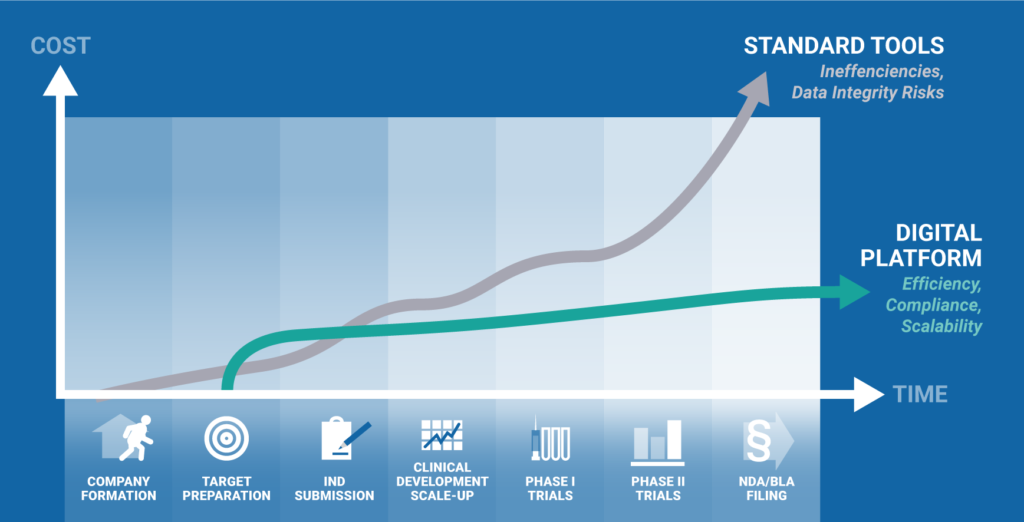
The Cost of Fragmented Tools
6 Indicators for Inspection Readiness
Inspection readiness is often misunderstood as preparing binders and cleaning up documentation, most of the times reacting shortly before an audit.
In reality, it is much broader.
Inspection readiness means the organization can consistently demonstrate
- traceability,
- controlled processes,
- documented oversight,
- role clarity,
- training compliance,
- and reliable retrieval of critical records.
Not occasionally. But continuously.
And manageable even when central staff members have left the company – the essence of ALCOA ++.
This is why the most resilient life science organizations increasingly think in terms of operating models rather than isolated systems.
The question is no longer simply: “What tool do we need?” The more important question is: “How do we want compliance, quality, documentation, and oversight to function operationally as we scale?”
Technology should support the model – not define it.
Operational Readiness Becomes Investor Readiness
In today’s biotech environment, investors evaluate more than science.
They also assess whether a company can scale responsibly.
- Can the organization demonstrate control?
- Can it retrieve critical documentation quickly?
- Can it prove oversight across outsourced activities?
- Can it maintain traceability as complexity increases?
- Is pre-clinical and clinical data creation, handling and storage in compliances with GXP?
Companies that establish compliant digital foundations early are often able to move faster later – with less remediation, lower operational friction, and greater confidence across stakeholders.
This does not mean emerging biotech companies need overly complex enterprise infrastructures from day one. In fact, overengineering can create its own problems.
But it does mean building processes and systems that are scalable, structured, inspection-supportive and designed for growth.
Because eventually, every growing biotech reaches the same point:
The science alone is no longer enough. Operational maturity becomes part of the company’s credibility.
And by then, the organizations that built inspection readiness into their operating model from the beginning are usually in a far stronger position than those trying to retrofit control under pressure.
This is exactly why emerging biotech companies should think about inspection readiness long before an inspection is announced.
Because once pressure arrives – from investors, partners, or regulators – building the right operational foundation becomes significantly more difficult.
In our whitepaper, “Inspection-Ready by Design: Why Emerging Biotechs Should Build a Compliant Digital Foundation” we explore how growing life science companies can reduce compliance debt, strengthen operational control, and build readiness into the way they work.
Download the whitepaper and learn how to build inspection readiness by design: